

In the world of mathematics, the term “vertex” holds significant importance across various branches, especially in geometry and algebra. A vertex represents a point where two or more lines, edges, or curves meet, playing a crucial role in understanding shapes and structures. Whether it’s the corners of a polygon or the peak of a parabola, vertices are fundamental to analyzing and describing geometric figures.
Understanding vertices can enhance one’s grasp of mathematical concepts, making it easier to tackle problems related to graphs, shapes, and equations. As students delve into geometry or algebra, recognizing the role of a vertex becomes essential for mastering more complex ideas. This article explores the definition of a vertex, its applications, and why it matters in the broader context of mathematics.
What Is Vertex in Math
A vertex represents a key point in various mathematical contexts. In geometry, it describes a corner point of a polygon or a polyhedron, where two or more edges meet. For example, a triangle possesses three vertices, while a square has four. Each vertex plays a crucial role in defining the shape’s structure and properties.
In algebra, the term vertex also relates to parabolic functions, where it identifies the highest or lowest point on the graph of a quadratic equation. This point indicates either a maximum or minimum value, significantly influencing the function’s behavior. For instance, the vertex of the quadratic function (y = ax^2 + bx + c) can be found using the formula ((-b/2a, f(-b/2a))).
In graph theory, a vertex denotes a fundamental unit of a graph. Each vertex connects to other vertices through edges, forming relationships and structures essential for analyzing networks and systems. In this context, recognizing vertices aids in understanding connectivity and pathways within the graph.
Understanding the vertex’s definition and applications across mathematics promotes better problem-solving skills and deepens comprehension of geometrical and algebraic concepts.
Importance of Vertex
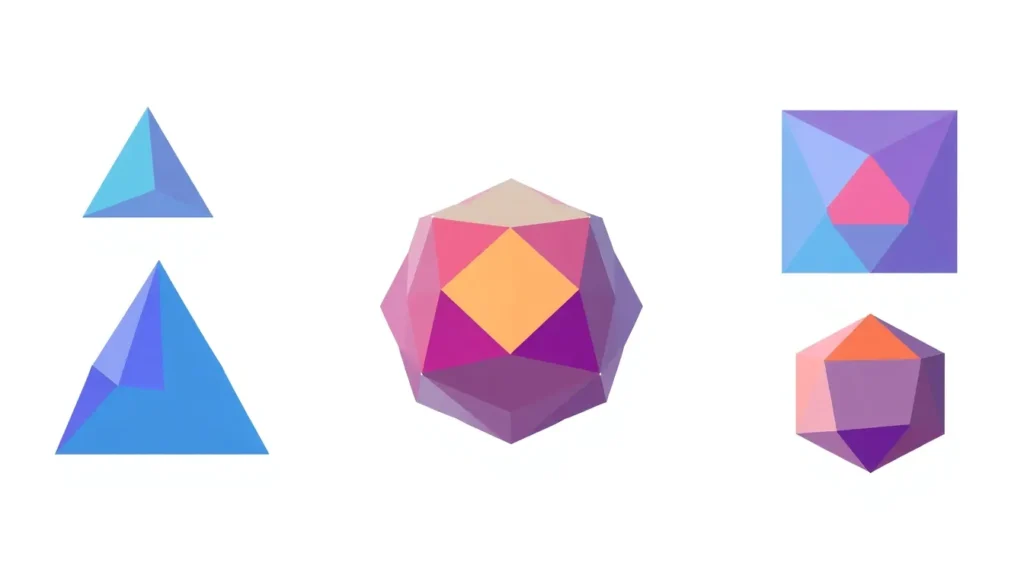
Understanding the significance of vertices enhances comprehension of various mathematical concepts. Vertices serve pivotal roles in geometry, algebra, and graph theory.
In Geometry
In geometry, vertices define the corners of polygons and polyhedra. They contribute to establishing the shape and characteristics of geometric figures. For instance, a triangle possesses three vertices, while a square features four. The arrangement and connection of these vertices dictate angles and area calculations. Recognizing vertices aids in identifying congruence and similarity among shapes, facilitating the analysis of geometric properties.
In Algebra
In algebra, the vertex of a parabola signifies the maximum or minimum value of a quadratic function. This point directly influences the graph’s trajectory. Identifying the vertex simplifies solving quadratic equations and optimizing functions. For example, in the equation (y = ax^2 + bx + c), the vertex occurs at ((-b/2a, f(-b/2a))), allowing individuals to determine the parabola’s highest or lowest point efficiently. Understanding this concept plays a crucial role in graphing and function analysis.
Types of Vertices
Vertices appear in various mathematical contexts, each serving distinct purposes. Understanding these types enhances comprehension of geometric shapes and structures, as well as algebraic functions and graph theory.
Vertices in Polygons
Vertices in polygons represent the corner points where two edges meet. For instance, a triangle has three vertices labeled A, B, and C, while a square contains four vertices labeled P, Q, R, and S. Each vertex is critical in defining a polygon’s properties, such as angles and perimeter. The sum of interior angles in a polygon can be calculated using the formula ((n – 2) times 180) degrees, where (n) is the number of vertices. Recognizing vertices assists in analyzing congruence, similarity, and symmetry among various polygonal shapes.
Vertices in Graphs
Vertices in graphs act as fundamental units, representing entities in a network. For example, in a social network graph, each vertex might represent a person. Edges connect vertices, signifying the relationship between them. An undirected graph’s vertices do not exhibit directional relationships, while a directed graph shows a relationship from one vertex to another. Evaluating vertices aids in understanding network properties, such as connectivity and shortest paths. Graph theory utilizes these concepts to solve complex problems in computer science, logistics, and social dynamics.
How to Find a Vertex
Finding a vertex depends on the mathematical context. Different methods apply when determining vertices in parabolas and polygons.
Finding the Vertex of a Parabola
To find the vertex of a parabola represented by the quadratic equation ( y = ax^2 + bx + c ), use the formula for the x-coordinate of the vertex: ( x = -frac{b}{2a} ). Substitute this x-value back into the equation to find the corresponding y-coordinate. For instance, in the equation ( y = 2x^2 + 4x + 1 ):
- Identify ( a ) and ( b ): ( a = 2 ), ( b = 4 ).
- Calculate ( x ): ( x = -frac{4}{2 times 2} = -1 ).
- Substitute ( x ) into the equation: ( y = 2(-1)^2 + 4(-1) + 1 = -1 ).
The vertex in this example occurs at the point (-1, -1).
Finding Vertices in Polygons
To find the vertices of polygons, list all corner points where edges meet. Each vertex is denoted as a coordinate point in a two-dimensional space. For instance, a triangle with vertices A(1, 2), B(4, 6), and C(2, 5) reveals three corner points. These vertices are crucial for calculating perimeter and area.
For polygons, the formula for finding the sum of interior angles is ( (n – 2) times 180 ) degrees, where ( n ) represents the number of vertices. For example, a hexagon with 6 vertices has a sum of interior angles equal to ( (6 – 2) times 180 = 720 ) degrees.
Vertex Form in Mathematics
Vertex form is a specific way to express a quadratic function that highlights its vertex. The vertex form of a quadratic equation is given by:
[ y = a(x – h)^2 + k ]
In this equation, ((h, k)) denotes the vertex, with (h) representing the x-coordinate and (k) representing the y-coordinate. This format allows for easy identification of the vertex and simplifies graphing.
Finding the vertex using vertex form is straightforward. To locate the vertex, one simply reads the values of (h) and (k) from the equation. For example, in the equation (y = 2(x + 3)^2 – 5), the vertex is found at ((-3, -5)).
Using vertex form has advantages in graphing parabolas. The vertex serves as the highest or lowest point on the parabola, depending on the value of (a). If (a > 0), the parabola opens upwards, with the vertex being the minimum point. Conversely, if (a < 0), the parabola opens downwards, and the vertex is the maximum point.
Vertex form also aids in determining the axis of symmetry, which is the vertical line that passes through the vertex. The equation of the axis of symmetry can be expressed as:
[ x = h ]
In the above example, the axis of symmetry is represented by the line (x = -3).
Furthermore, transforming a standard quadratic equation to vertex form can enhance problem-solving efficiency. For instance, given the standard form equation (y = x^2 + 6x + 5), one can complete the square to convert it into vertex form. This yields:
[ y = (x + 3)^2 – 4 ]
Here, the vertex ((-3, -4)) can be readily identified, clarifying characteristics of the quadratic function.
Understanding vertex form and its elements is essential for grasping the behavior of quadratic functions, making it a significant concept in mathematics.
Understanding vertices is essential for grasping various mathematical concepts. They play a pivotal role in geometry by defining shapes and their properties. In algebra, vertices help identify critical points in quadratic functions, influencing their behavior and solutions.
In graph theory, vertices serve as fundamental units that connect through edges, forming networks that reveal important relationships. Mastering the identification and application of vertices can significantly enhance problem-solving skills and deepen one’s comprehension of mathematical principles. This foundational knowledge equips learners to tackle more complex topics with confidence.