A mansion kitchen isn’t just a place to cook, it’s a statement of craftsmanship, quality, and thoughtful design. Unlike standard residential kitchens constrained by square footage and budget, mansion kitchens have the space and resources to incorporate professional-grade equipment, custom millwork, and materials that most homeowners only see in showrooms. But that freedom comes with its own challenges: poor planning can turn a 600-square-foot kitchen into an inefficient maze, and expensive finishes won’t compensate for bad layout or inadequate lighting. This guide walks through the core elements that separate a truly functional luxury kitchen from one that just looks expensive.
Table of Contents
ToggleKey Takeaways
- A mansion luxury kitchen balances aesthetic ambition with practical function through thoughtful planning of multiple dedicated work zones, ensuring efficiency doesn’t get compromised by expensive finishes alone.
- Premium materials like book-matched quartzite, ¾-inch plywood cabinetry with dovetail joinery, and high-end hardware transform a mansion kitchen from visually impressive to genuinely durable and long-lasting.
- Professional-grade appliances—including 48 to 60-inch dual-fuel ranges, multiple refrigeration units, and specialty features like steam ovens and pot fillers—define luxury kitchen functionality at scale.
- Proper ceiling height (10 to 12 feet), layered lighting with task, ambient, and accent layers, and detailed traffic flow planning separate truly luxurious kitchens from those that merely look expensive.
- Custom cabinetry designed around actual usage patterns, combined with optimized storage solutions like pull-out drawers and walk-in pantries, maximizes usability in mansion kitchens ranging from 400 to 1,000+ square feet.
What Defines a Luxury Kitchen in a Mansion?
Scale and proportion matter more than most people expect. A luxury mansion kitchen typically ranges from 400 to 800 square feet, though some exceed 1,000. At that size, you’re not just enlarging a standard kitchen, you’re creating multiple work zones that need to function independently without interfering with each other.
The defining characteristic is dedicated zones for specific tasks: a baking station with marble counters and a built-in proofer, a beverage prep area with an undercounter ice maker and wine fridge, a cleanup zone isolated from cooking traffic. Standard kitchens force you to share counter space and appliances: mansion kitchens eliminate that compromise.
Material quality shifts from acceptable to permanent. Countertops aren’t just granite, they’re book-matched quartzite slabs or honed Calacatta marble with full-height backsplashes. Cabinet boxes use ¾-inch plywood construction with dovetail joinery, not particleboard with veneer. Hardware is solid brass or stainless, not zinc alloy with plating that wears through.
Ceiling height plays a larger role than most design blogs admit. A 10- to 12-foot ceiling allows for proper ventilation duct sizing, taller upper cabinets, and statement lighting that doesn’t hang into sightlines. Standard 8-foot ceilings make high-CFM range hoods look awkward and limit your options for pendant fixtures over islands.
Premium Materials and Finishes That Elevate Your Kitchen
Countertop selection goes beyond aesthetics, it’s about choosing the right material for each zone. Quartzite offers the look of marble with better resistance to etching, making it practical for perimeter counters near the range. Actual marble works well for dedicated baking stations where you want a cool, smooth surface for pastry work. Avoid it near the sink or anywhere citrus and wine are likely to contact the surface regularly.
Cabinet finish options in luxury kitchens include hand-rubbed lacquer, conversion varnish, and oil-based polyurethane, each with different durability and maintenance profiles. Lacquer provides the smoothest finish but shows wear more readily than conversion varnish. Oil-based poly holds up to heavy use but can yellow over time, which matters if you’re using white or light-colored cabinetry.
Flooring needs to handle weight and moisture without compromising the design. Wide-plank hardwood (7 to 10 inches wide) in white oak or walnut brings warmth, but it requires proper acclimation, let it sit in the space for at least 72 hours before installation to prevent gapping. Porcelain tile that mimics natural stone offers better moisture resistance and works well in kitchens that see heavy use or have radiant floor heating.
Backsplash treatments range from slab marble carried to the ceiling, to handmade zellige tile, to book-matched stone. Full-height stone slabs eliminate grout lines but require careful templating and blocking in the wall to support the weight. Tile offers more flexibility in pattern and color but introduces maintenance, plan for ⅛-inch grout lines with epoxy grout to minimize staining.
High-End Appliances Every Mansion Kitchen Should Have
A professional-style range anchors most luxury kitchens, 48 to 60 inches wide, with at least six burners delivering 15,000 to 25,000 BTUs on high-output positions. Dual-fuel models pair gas cooktops with electric convection ovens for better baking control. Brands like Wolf, La Cornue, and BlueStar offer commercial-grade performance, but they also require adequate ventilation, plan for a range hood with at least 1,200 CFM and makeup air if local code requires it (many jurisdictions mandate makeup air for hoods over 400 CFM).
Refrigeration in mansion kitchens often includes multiple units: a 48-inch built-in column refrigerator and freezer for daily use, plus an undercounter beverage fridge and a separate wine storage unit with dual-zone temperature control. Panel-ready models let you match cabinetry for a seamless look, but verify that your cabinet shop can handle the weight, a 48-inch built-in fridge can exceed 500 pounds and requires blocking anchored to wall studs.
Advanced homeowners planning integrated smart technology can tie appliances into home automation systems for remote monitoring and control.
Specialty appliances that make sense at this scale include steam ovens for vegetables and seafood, warming drawers to hold plated dishes at serving temperature, and built-in espresso machines with automatic milk frothers. A pot filler mounted over the range eliminates carrying heavy stockpots across the kitchen, install it 12 to 18 inches above the cooktop and on a dedicated shutoff valve.
Dishwashers in luxury kitchens are often panel-ready models installed in pairs, one for everyday use, one for glassware or to handle overflow during entertaining. Look for models with third racks for flatware and utensils, and decibel ratings under 44 dB if the kitchen is open to living spaces.
Layout and Space Planning for Maximum Functionality
The classic work triangle (sink, range, refrigerator) gets replaced by multiple work zones in mansion kitchens. Each zone should have dedicated counter space, 36 inches minimum on at least one side of the cooktop, 24 inches of landing space beside the refrigerator, and 36 inches between the sink and nearest appliance or wall.
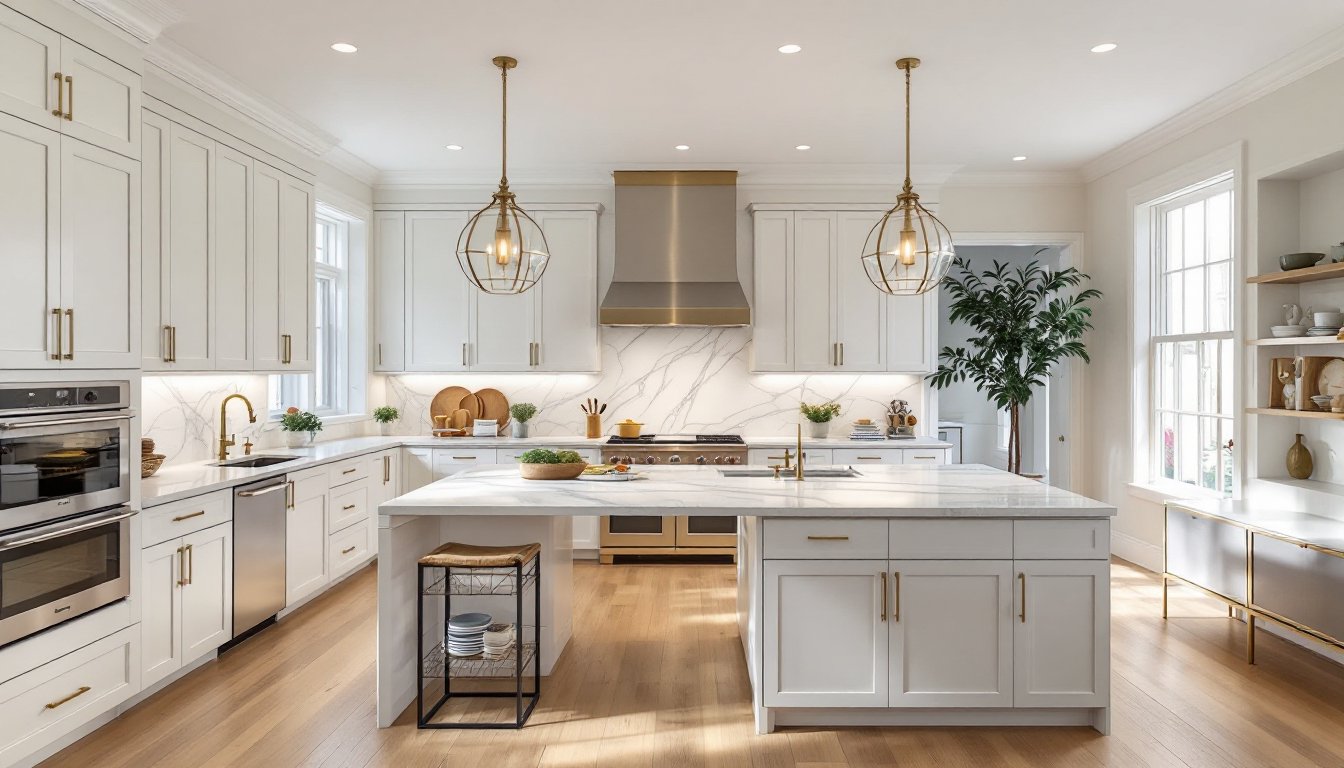
Island sizing needs careful calculation. A kitchen island should be at least 4 feet long by 2 feet deep to be functional, but mansion kitchens often feature islands 8 to 12 feet long with integrated seating, secondary sinks, or cooktops. Allow 42 to 48 inches of clearance on all sides for traffic flow, more if the island includes seating or if multiple cooks will be working simultaneously.
Perimeter counter depth is typically 25 inches (24-inch base cabinets plus a 1-inch overhang), but luxury kitchens sometimes use deeper counters, 27 to 30 inches, to accommodate larger sinks or provide more workspace. Verify that deeper counters won’t make upper cabinets unreachable: the ideal height for uppers is 18 inches above the counter, with a maximum reach of 54 inches from the floor.
Professional designers working on luxury mansion interiors often create separate prep kitchens or catering kitchens adjacent to the main space, particularly for clients who entertain frequently.
Traffic patterns matter more in large kitchens. Avoid placing the main refrigerator or pantry at the far end of the kitchen, away from the entry, it forces traffic through the work zones. Position high-traffic appliances and storage near the entry, and reserve the interior for focused cooking tasks.
Statement Lighting and Fixture Choices
Layered lighting separates functional kitchens from showpieces. You need three types: task lighting for work surfaces, ambient lighting for overall illumination, and accent lighting for visual interest. Many professional kitchen designers prioritize lighting before selecting finishes.
Task lighting over counters comes from undercabinet LED strips, install them toward the front edge of the cabinet, not the back, to minimize shadows. For islands, use pendant fixtures or a linear suspension light positioned 30 to 36 inches above the counter. If the island includes seating, raise pendants to 36 to 40 inches to keep them out of sightlines.
Ambient lighting in kitchens with tall ceilings often requires recessed cans on a 4- to 6-foot grid, supplemented by cove lighting or a statement chandelier. Use LED downlights with 90+ CRI (Color Rendering Index) to render food and finishes accurately, cheap LEDs with CRI below 80 make everything look washed out.
Accent lighting highlights architectural features: LED strips inside glass-front cabinets, toe-kick lighting along the base cabinets, or directional track lights aimed at artwork or a feature backsplash. Install all accent lighting on separate switches or dimmers so you can adjust the mood for entertaining.
Fixture finish should match or complement your cabinet hardware and plumbing fixtures. Mixing metals can work, brushed nickel pendants with unlacquered brass hardware, for example, but limit yourself to two metal finishes maximum to avoid a cluttered look.
Custom Cabinetry and Storage Solutions
Custom cabinetry in mansion kitchens means more than picking a door style, it’s about designing storage around how the space will actually be used. Frameless (European-style) cabinets provide slightly more interior space and a cleaner, modern look, while face-frame cabinets offer a more traditional aesthetic and easier door adjustment down the line.
Interior organization makes or breaks usability. Deep base cabinets should have pull-out drawers or rollout trays, fixed shelves force you to crouch and dig for items in the back. Drawers work better than doors for pots, pans, and small appliances. Use full-extension drawer slides rated for 100 pounds to handle cast iron and stockpots without sagging.
Pantry options in luxury kitchens include walk-in pantries with adjustable shelving and task lighting, tall pull-out pantry cabinets (12 to 24 inches wide) with racks on both sides, or butler’s pantries that double as prep and staging areas. A well-designed pantry should store dry goods, small appliances, and serving pieces without overcrowding, allocate at least 10 to 15% of your total kitchen square footage to pantry space.
Specialty storage adds convenience: a vertical tray divider for sheet pans and cutting boards, a spice drawer with angled inserts so labels are visible, pull-out bins for recycling and compost, and charging drawers with built-in outlets for tablets and phones.
Drawer and door fronts should be ¾-inch thick solid wood or veneer over engineered core, avoid thin ⅝-inch fronts that warp over time. Dovetail or dowel joinery holds up better than stapled or glued drawer boxes, particularly in drawers that see heavy daily use. Many high-end kitchens featured on luxury interior design platforms showcase custom storage solutions integrated into the overall layout.
Conclusion
Building a mansion luxury kitchen requires balancing aesthetic ambition with practical function, choosing materials that perform as well as they photograph, laying out zones that reduce wasted movement, and integrating appliances and storage that match how the space will actually be used. The difference between an expensive kitchen and a truly luxurious one comes down to decisions made during planning, not just the price tags on the finishes.